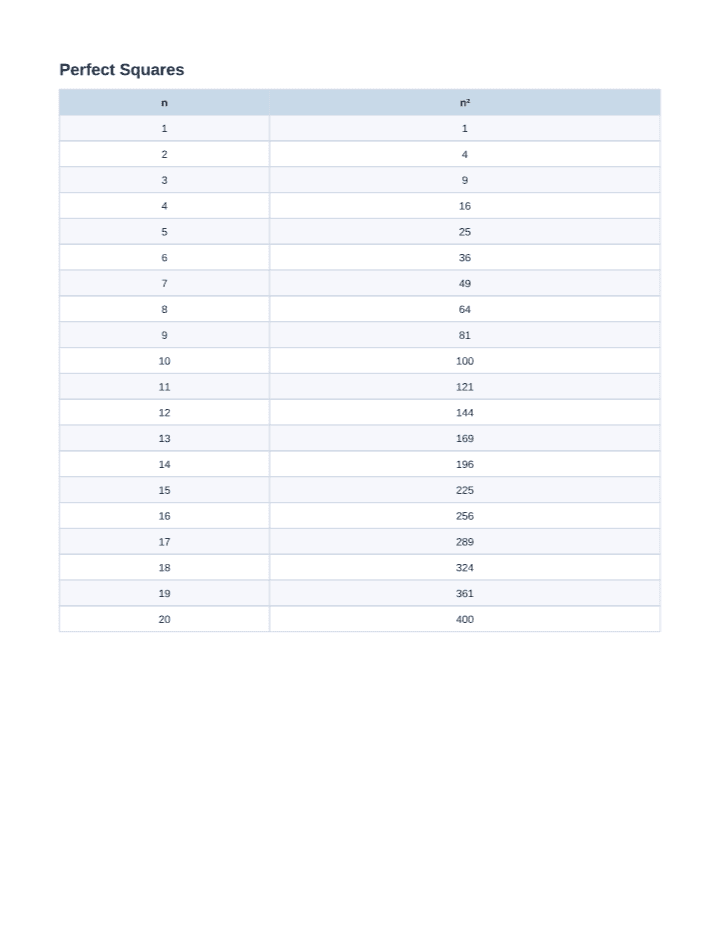
Perfect Squares Chart 1–20
LETTER · A4 · Portrait · Free PDF
Free · No sign-up · Instant download
Free printable perfect squares reference chart PDF. Shows every perfect square from 1² = 1 to 20² = 400 in a clear two-column layout. An essential desk reference for middle school math, algebra, and standardized test prep. Available in Letter and A4.
About This Perfect Squares Chart 1–20
Free printable perfect squares reference chart PDF. Shows every perfect square from 1² = 1 to 20² = 400 in a clear two-column layout. An essential desk reference for middle school math, algebra, and standardized test prep. Available in Letter and A4. This printable is available in US Letter (8.5 × 11 inch) and A4 (210 × 297 mm). All files print correctly at 100% scale on any home or office printer.
Specifications
- Table range
- 1 × 1 to 20 × 20
- Total cells
- 441 cells (20×20 + headers)
- Chart type
- Filled (completed)
- Recommended grade
- Grade 4–6
- Available sizes
- US Letter, A4
Printing Tip
For a durable classroom reference, print on cardstock and laminate. For practice, print weekly and use a timer — regular timed sessions help students notice their own progress.
Usage Rights
PrintableCove's perfect squares chart 1–20 is free to download and print for personal, classroom, and homeschool use. No account required, no watermarks, no expiry date. You may print unlimited copies for your students or children. Please do not redistribute or resell the PDF files — if you want to share this resource, link to this page instead.