PrintableCove
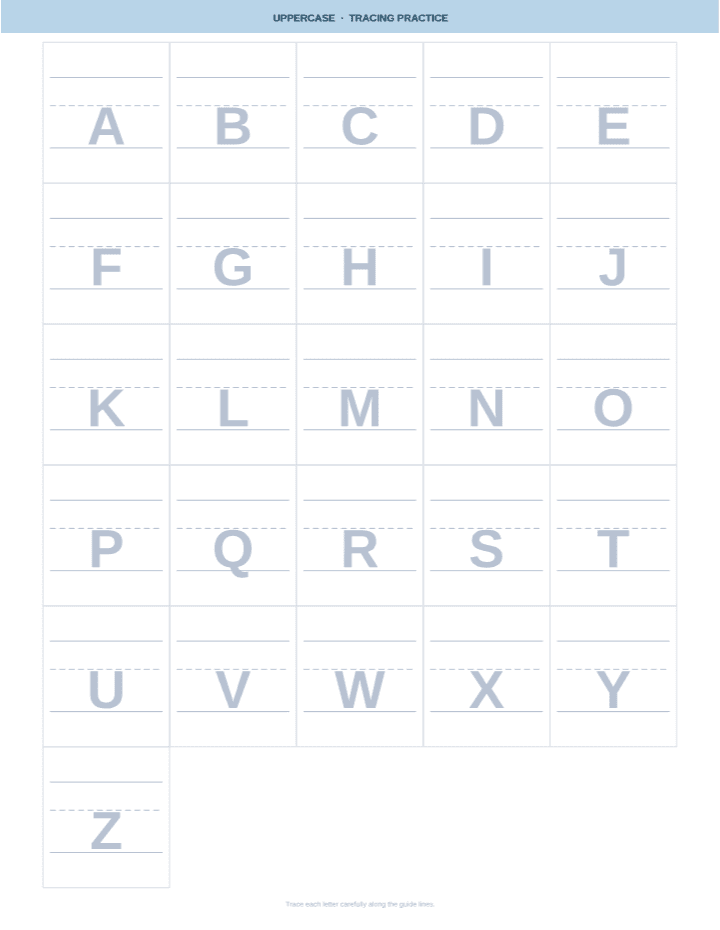
Uppercase Alphabet Tracing printable PDF preview — letter size
PDF

Uppercase Alphabet Tracing

LETTER · A4 · Portrait · Free PDF

Free · No sign-up · Instant download

Free printable uppercase alphabet tracing worksheets PDF. All 26 capital letters A–Z with dotted tracing guides and practice lines. For preschool and kindergarten children ages 3–6. Tracing builds fine motor skills, pencil grip, and letter recognition while helping children memorize correct stroke patterns. Available in Letter and A4.

About This Uppercase Alphabet Tracing

Free printable uppercase alphabet tracing worksheets PDF. All 26 capital letters A–Z with dotted tracing guides and practice lines. For preschool and kindergarten children ages 3–6. Tracing builds fine motor skills, pencil grip, and letter recognition while helping children memorize correct stroke patterns. Available in Letter and A4. This printable is available in US Letter (8.5 × 11 inch) and A4 (210 × 297 mm). All files print correctly at 100% scale on any home or office printer.

Specifications

Letters covered
A-Z (26 uppercase)
Worksheet style
Tracing
Layout
5 columns × 6 rows
Guide lines
Baseline, midline, and top line per cell
Available sizes
US Letter, A4

How It Compares

Uppercase letters are typically taught before lowercase because their forms are more distinct and easier for young children to differentiate. The uppercase tracing worksheet is usually the first letter worksheet children use, around ages 3–5. Once uppercase is mastered, introduce the lowercase tracing worksheet to build the full alphabet skill set.

Printing Tip

Use a soft pencil (HB or 2B) for tracing so children can erase and retry. Have them trace each letter 3 times before writing independently on the blank lines.

Usage Rights

PrintableCove's uppercase alphabet tracing is free to download and print for personal, classroom, and homeschool use. No account required, no watermarks, no expiry date. You may print unlimited copies for your students or children. Please do not redistribute or resell the PDF files — if you want to share this resource, link to this page instead.

Frequently Asked Questions

Alphabet tracing worksheets are designed for children ages 3–6 in preschool (Pre-K) and kindergarten. Most children are developmentally ready to begin letter tracing around age 3–4, when their fine motor skills are advanced enough to control a pencil. By age 5–6, children typically move from tracing to independent letter writing.

Most handwriting educators recommend starting with uppercase letters because they are formed with simpler strokes. Capital letters are mostly made of straight lines and large curves — A, E, F, H, I, L, T are all straight lines. Lowercase letters include more complex strokes like small curves, bumps, and descenders (letters that go below the baseline like g, j, p, q, y). Building confidence with uppercase first makes the transition to lowercase easier.

Tracing letters develops five key skills simultaneously: (1) Fine motor control — strengthening the small muscles of the hand needed for writing; (2) Proper pencil grip — the physical action of following dotted paths builds correct finger positioning; (3) Muscle memory — repeated tracing encodes letter formations in procedural memory, so children can eventually write letters automatically; (4) Letter recognition — seeing and tracing each letter reinforces its visual shape; (5) Hand-eye coordination — following the dotted path requires eyes and hand to work together.

3–5 repetitions per session is a good target for young children — enough practice without leading to fatigue or frustration. Our worksheets provide dotted outlines plus additional practice lines so children can trace the model letter, then attempt several copies on their own.

A regular pencil (or a thick pre-school pencil for very young children) is ideal for tracing worksheets, as it closely mimics what children will use for writing in school. Crayons work too, especially for younger children who have not yet developed full pencil control. The key is using a writing tool that requires some grip pressure — this builds the hand muscles more effectively than a marker.

More Alphabet Tracing

You Might Also Need